
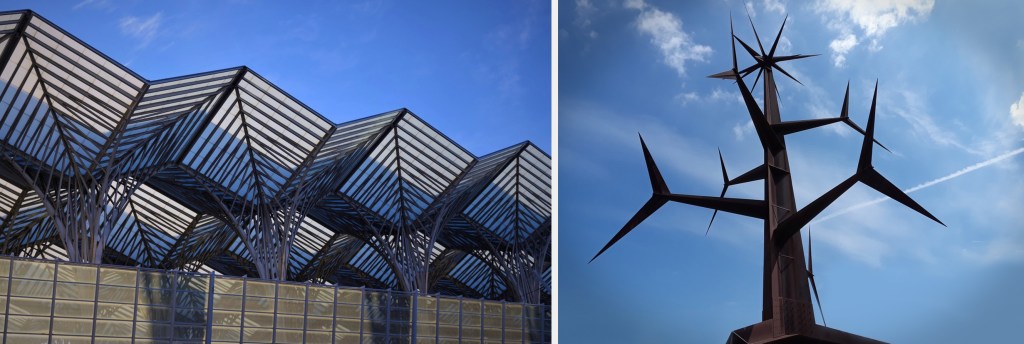
Another of my favorite places in Lisbon is along the waterfront in the northeastern part of the city. Since we had only stayed near Rossio Square on prior visits, this newer part of the city was both a surprise and a contrast to the Lisbon we thought we knew. On our first visit here, we stayed in an upscale hotel just across from the Oriente Station. Conceived by the Spanish architect Santiago Calatrava, Oriente is the jewel of the Portuguese rail network. Completed in 1998, this modern station is a bright glass and steel structure in the form of a tree. The ambitious project includes a metro station, a national and international bus terminal, and a high-speed and regional train hub. A large shopping mall, Vasco da Gama Center, is across the road. Besides all the usual stores and fast-food options typical of any mall, it has several restaurants that are both good and reasonably priced. And there’s a large outdoor seating area for dining al fresco.
Just outside of the mall, you’ll find a huge outdoor park that extends all the way to the waterfront. Parque das Nações (Park of Nations) was constructed for the World Exposition of 1998 on a 3.1-mile (5 km) strip of land along the Tagus River. The city bought the abandoned land and undertook the daunting task of creating a space worthy of a world stage. Not only did Expo ’98 commemorate the 500th anniversary of explorer Vasco da Gama’s voyage to India, but it was also the 100th world exposition ever to take place.
Art can be found everywhere here: streets, squares, gardens, walls, and even the pavement. Both architecture and art join the natural surroundings in creating a unique leisure area. Numerous restaurants, bars, theatres, parks, and pedestrian areas make it a haven for both locals and tourists. Speaking of art, the impressive Homen-Sol (Man-Sun) sculpture by Portuguese artist Jorge Ricardo da Conceição Vieira is a prominent feature. At 66 feet (20 meters) tall and weighing 15 tons, the sculpture combines surrealism with abstraction in dramatic fashion.
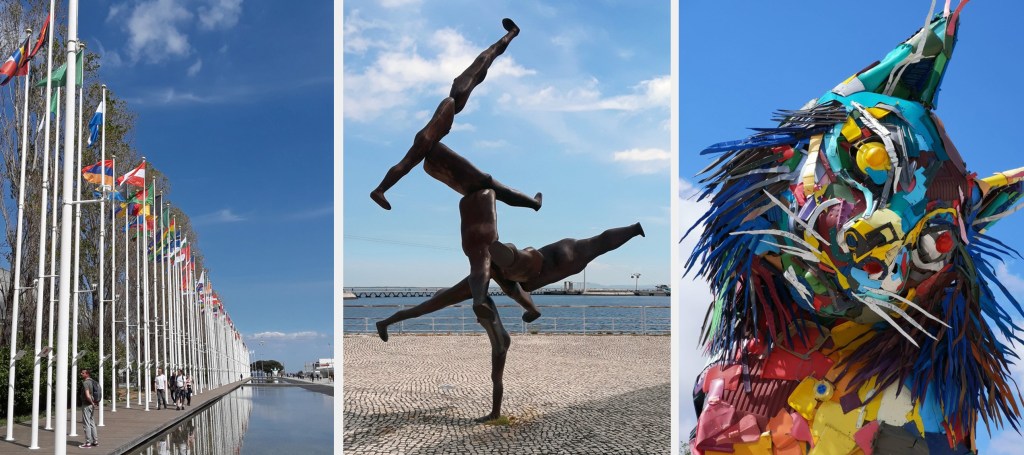
Continuing towards the waterfront you’ll find a reflecting pool flanked by flags, which represent the countries that participated in Expo ’98. It’s especially beautiful on a sunny day when all the colorful flags are reflected in the pool. The iron sculpture Rhizome by English artist Antony Gormley stands out against the sky. The piece consists of nine life-size human figures that symbolize the union between men and resembles the branches of a tree. My favorite piece in the park is the large and colorful Iberian Lynx created by the Portuguese artist Bordalo II. Made entirely of trash (mainly plastic) the work is part of his Big Trash Animals series. There are currently 195 Big Trash Animals, spread all over the world. Bordalo uses garbage, the same material that kills them, to provoke a different look at our consumerist habits. Very thought provoking.
The stunning Lisbon Oceanarium is a short stroll from here.
I fell in love with aquariums on my first visit to the one in Cleveland, Ohio as a kid. There’s just something magical about observing a world so different than ours yet part of our planet.
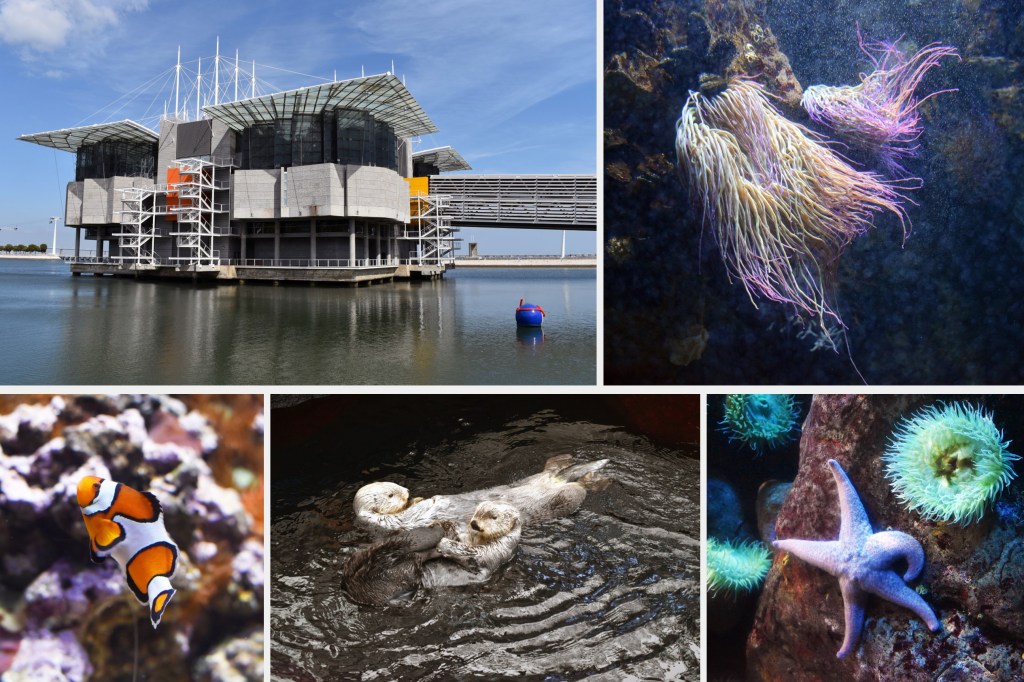
The Lisbon Oceanarium is the largest indoor aquarium in Europe and a must see when you visit this part of the city. Its large collection of marine species totals about 16,000 individuals of 450 species. The main water tank holds 1.32 million gallons (5 million liters) of water and is home to over 100 species from around the world including sharks, rays, barracudas, groupers, and moray eels. It’s made up of four separate marine habitats creating the illusion of a single aquarium and features terrestrial and marine ecosystems, as well as the temperate, tropical, and cold waters of the Earth’s oceans. The tank is massive and a 530 square foot (49 square meter) acrylic window on each side offers visitors a stunning view inside. The exhibit also has smaller windows spaced around it and benches. I could have easily sat there for hours watching the constant motion of this amazing underwater world.
In addition to the main tank, there are a several rooms with habitats featuring amphibians, invertebrates, and fish from around the world including a Giant Pacific Octopus, Purple Sea Urchin, White-Spotted Jellyfish, Blacknose Shark, Bull Ray, and the Great Barracuda. The Oceanarium also has a large display of birds including Atlantic Puffins, Common Murres, Inca Terns, and two species of Penguins, the Magellanic and the Southern Rockhopper. There’s an outdoor garden with plant species from Africa, Asia, Europe, and the Americas. And finally, my favorite display of all, two Pacific Sea Otters. Watching these cute mammals play and swim will brighten anyone’s day! Tickets are €19.00 for adults with a discount for seniors and children.
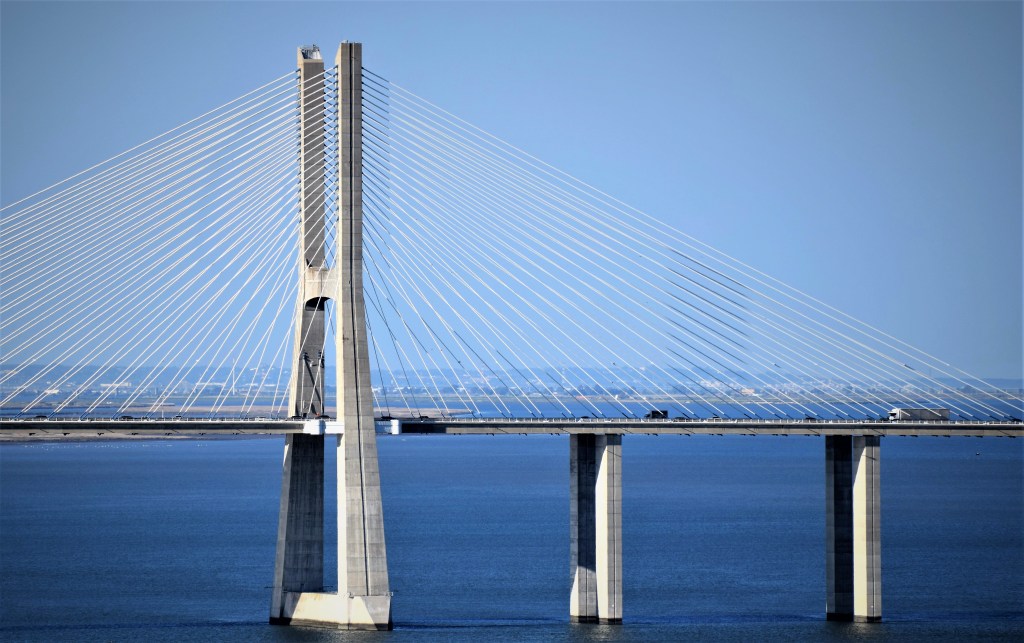
A short walk from the Oceanarium brings you to the south station of Telecabine Lisboa, a gondola ride over the Tagus River estuary. The ride along the 3/4-mile (1,230 meter) route takes about 12 minutes and carries you 98 feet (30 meters) above the river and offers a breathtaking panorama of the Park of Nations, Vasco da Gama Tower, and Vasco da Gama Bridge. Round trip tickets are €8.00 for adults with a discount for children. The north station affords amazing views of the Vasco da Gama Bridge, which is the largest bridge in Europe and the fourth longest in the world measuring 10.7 miles (17.2 km) long and 492 feet (150 meters) tall. It was built to withstand an earthquake four times stronger than the one that devastated Lisbon in 1755. Construction began in February 1995, and it was inaugurated on March 29, 1998, two months before the opening of the World Exposition. Its name commemorates the 500th anniversary of Vasco da Gama’s arrival in India, in May 1498.
Just past the Oceanarium, you’ll encounter a water themed space called Jardins da Água which features waterfalls, meandering rivers, and estuaries. Water Gardens is a team effort between landscape architect João Gomes da Silva and plastic artist Fernanda Fragateiro, who enrich the spaces design with a set of sculptural and tile pieces. Just west of Water Gardens is the Pavilhão do Conhecimento (Pavilion of Knowledge.) Designed by the architect Carrilho da Graça, it is an interactive science and technology museum that aims to make science more accessible to everyone. Through its exhibitions and activities, visitors explore the many and varied scientific themes in an active, relaxed, and playful way. Admission is €10.00 for adults with discounts for children and seniors.
Before heading back towards the Oriente Station, look for the installation called Water Volcanos. These emblematic “volcanoes” consist of six 13 feet (4 meter) tall cones with water games that repeat every 25 seconds for a total of 1,600 water eruptions per day. Covered with polychromatic tiles of different sizes and colors, they were made by Viuva Lamego.


 Travels with Terri
Leave a comment