
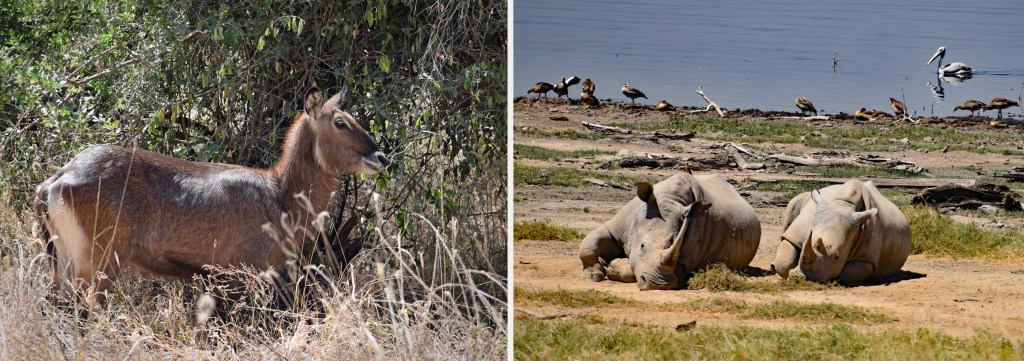
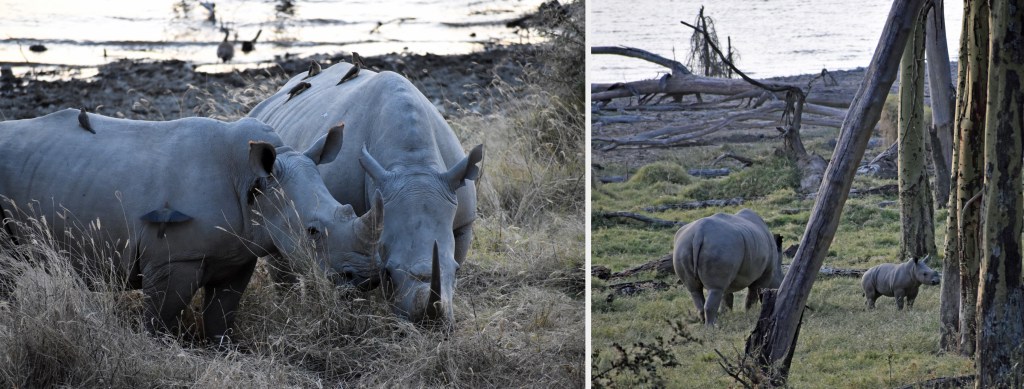
After breakfast, we headed to our next destination Lake Nakuru National Park. Since it was early in the day, Franco took us for a game drive before heading to our lodge. He told us that the park was established in 1961 and covers an area of 73 sq miles (188 sq kilometers.) Nakuru means “Dust or Dusty Place” in the Maasai language. Our first wildlife sighting was some female waterbucks close to the road. These members of the antelope family commonly rush into the water to avoid predators such as lions and leopards. As we approached the lake, Franco stopped the vehicle and pointed out a group of white rhinos sunbathing near the shore. Second only to elephants in size, rhinos need to live near water, so Lake Nakuru is a perfect spot for them to thrive. The Kenyan government created a rhino sanctuary inside the park to address the decline in rhino species across Kenya. The first two rhinos were introduced in 1984 and the park now has approximately 120 White Rhinos and 30 Black Rhinos. What a thrill to see these magnificent creatures in their natural environment!
Upon arrival at Sarova Lion Hill Game Lodge, we were greeted with fresh fruit juice and moist face towels. Our chalet style room was bright and airy with a sitting area, large bed, and a covered porch. After freshening up, we walked around the lush grounds stopping to admire the view of Lake Nakuru. Meals are served buffet-style and the choice of dishes is quite impressive. Besides soups, salads, fruits, and desserts, the hot food stations serve grilled meats and vegetables, and both Indian and Kenyan dishes. There are numerous vegetarian options, and all the dishes are labeled by spice level from mild to hot. One of the chefs told me that most of the produce is grown on-site in their farm-to-table garden. Our terrific meal was complimented by a guitarist/singer who performed many songs we know and love. After lunch we had time to relax by the pool before meeting Franco for our 4:00 pm game drive.

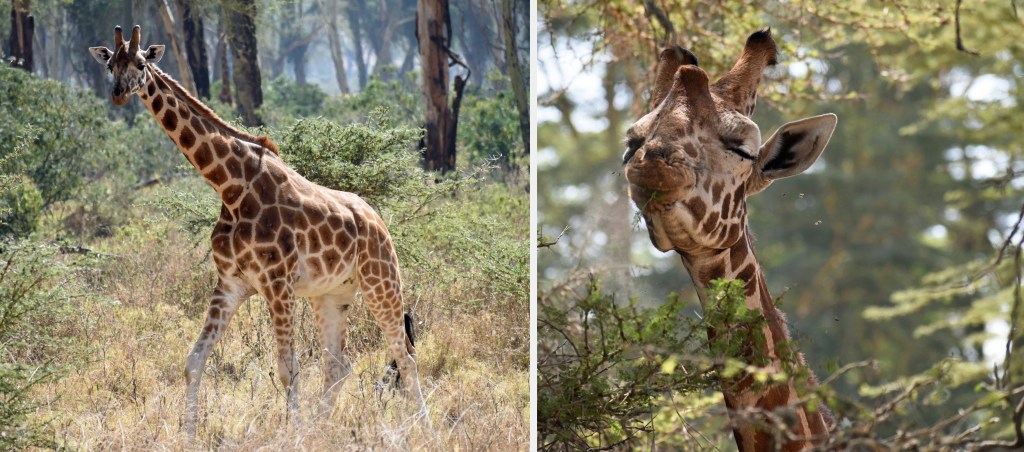
Shortly into our drive, we spotted a small group of Rothschild’s Giraffes feeding on tree leaves. As their herbivore diet is mostly leaves, stems, flowers, and fruit, the 550 different plant species in Lake Nakuru National Park provide them with an abundance of food. I’ll write more about these highly endangered animals in a future blog but here are a few notable facts:
- They were named after the London zoologist Lionel Water Rothschild who first described the subspecies in the early 1900’s.
- Males can eat up to 287 pounds (130 kilograms) of leaves in a day.
- They live in small herds with males and females living separately outside of the breeding season.
- Females give birth to a single calf after a gestation period of around 15 months.
- They have an impressive 17.72 inches (45 centimeters) long tongue which, together with their long neck, helps them to reach and pull down the branches of tall trees.
- A Rothschild’s Giraffe can grow up to 19.69 feet (6 meters) tall.
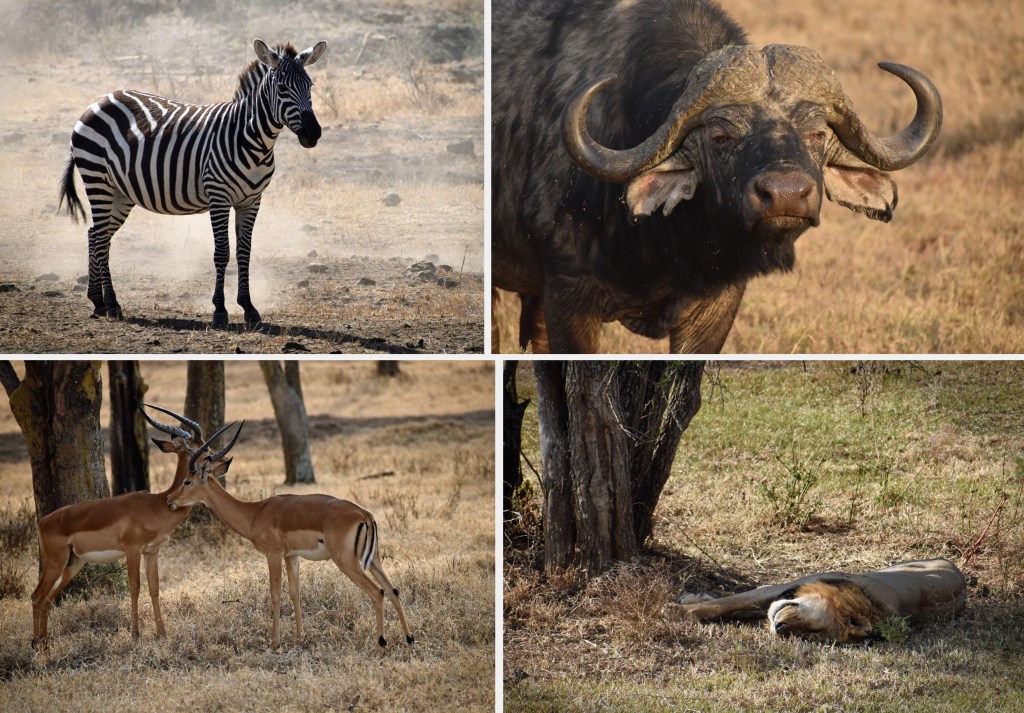
Lake Nakuru National Park is home to over 50 species of mammals, mostly herbivores. The main predators in the park are lions, cheetahs, and leopards. There are about 400 species of birds including greater and lesser flamingos, Kenyan fish eagles, giant herons, hamerkops, and pied kingfishers.
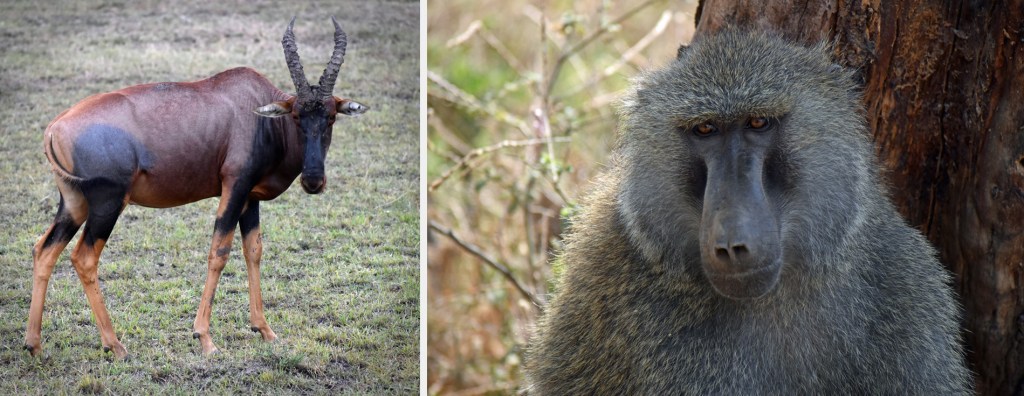
As the heat of the day faded, animals became more active searching for food and water. Franco pointed out a type of antelope we hadn’t seen before. Topis are medium-sized with a striking reddish-brown to purplish-red coat and tan legs. Both males and females have ringed horns that are between 11 to 16 inches (30 to 40 centimeters) long. Males can weigh between 198 to 324 pounds (90 to 147 kilograms) and females have a gestation period of 8 months.
A special treat for me was seeing a small group of banded mongooses. We’d seen them running around Kibo Safari Camp (and wandering through the dining room) and their cuteness totally charmed me. They are gregarious and live in groups of 10 to 20 members. Packs care for their young, sick, and elderly by feeding, grooming, and protecting them from danger. Their diet is mostly insects, lizards, snakes, and frogs but they will also eat fruit, eggs, and small rodents. Banded mongoose have been observed hunting together to kill larger prey like sand snakes. Their preferred den is old termite mounds, but they frequently change locations within a range of up to 1.6 sq miles (4 sq kilometers).

With sunset approaching, we headed back to our lodge. Franco spotted a group of white rhinos by the shore, enjoying a late day meal and drink. He told us that the birds perched atop the rhinos are called oxpeckers and that they feed on the ticks and other insects that prey on animals with hides. The perfect ending to our amazing day was seeing a female rhino with her young calf. We watched the pair for a long time and will never forget the joy we felt seeing the newest addition to Lake Nakuru National Park!
In my next blog we travel to Maasai Mara National Park, the main filming location for Out of Africa and home to big cats.


 Travels with Terri
Leave a comment