
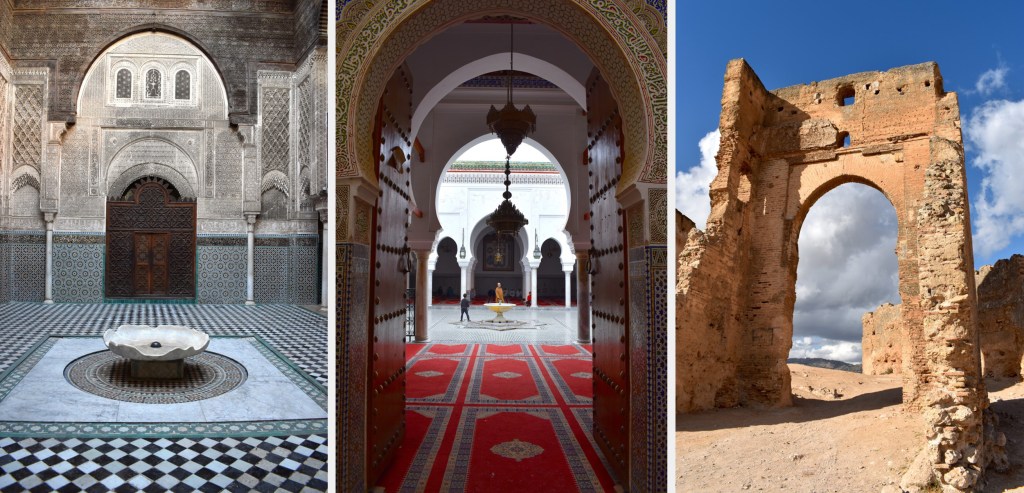
Fez Morocco is home to 785 mosques and the oldest university in the world. Located inside the Medina of Fez (Fes el Bali), Al-Quaraouiyine Mosque and University was founded by Fatima al-Fihri in 859 AD. As non-Muslims, we couldn’t go inside so we marveled at its stunning architecture and intricate tilework from the doorway. Our guide Mohammed told us about its history and about the Muslim faith. We listened intently as he explained the five pillars of Islam and how they guide the life of a Muslim. They are Profession of Faith (shahada), Prayer (salat), Alms (zakat), Fasting (sawm), and Pilgrimage (hajj). Prayer occurs five times a day, always facing the holy city of Mecca, in present-day Saudi Arabia. He also told us that by Islamic law, Muslims donate part of their income to community members in need. Learning about the cultures and customs of other countries is one of the many joys of travel.
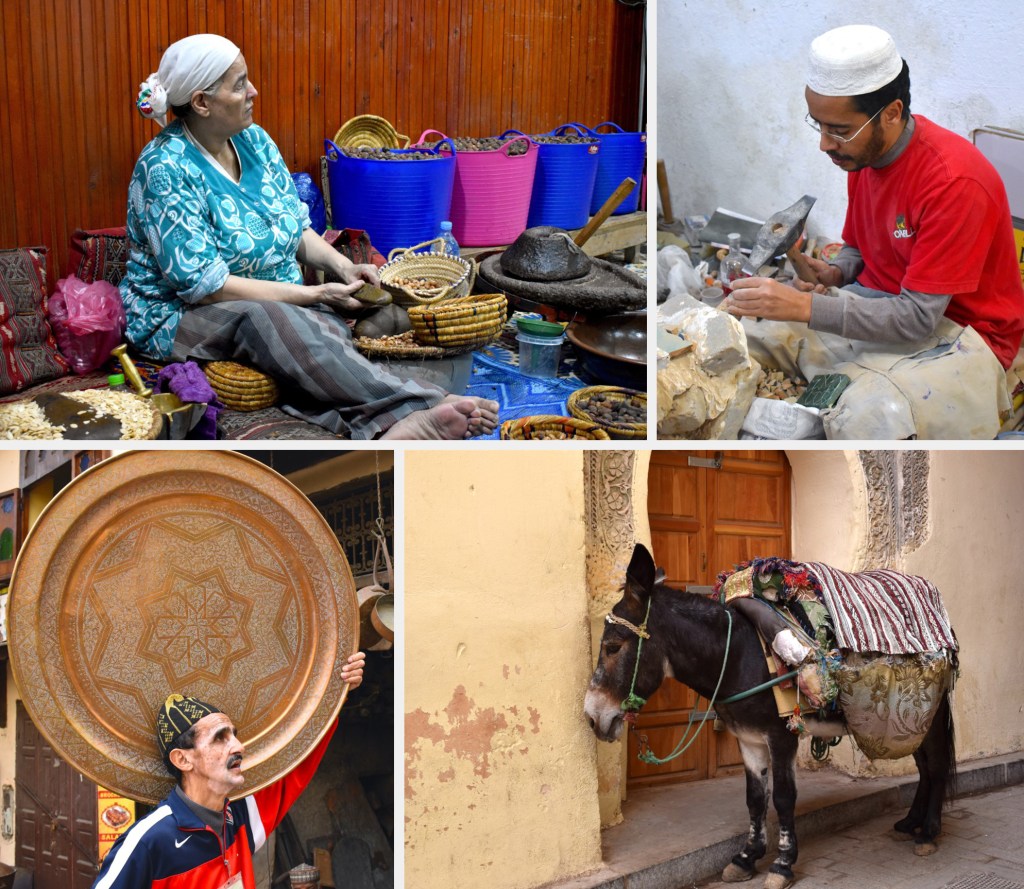
Morocco is famous for its spices and there are vendors selling them throughout the Medina. Full of vibrant colors and exotic fragrances, a visit to a spice shop is a treat for the senses. The owner of the one we visited offered us mint tea and showed us some of the various spices a woman was grinding by hand. He then showed us some saffron and explained why it’s the most expensive spice in the world (One-pound costs approximately $5,000.) Saffron comes from the Crocus sativus flower, commonly known as the “saffron crocus.” The term saffron applies to the flowers thread-like structures, or stigma. The flowers are harvested by hand at sunrise so that they are not damaged by direct heat from the sun. With each flower only producing three stigmas, it takes roughly 70,000 crocus flowers (210,000 stigmas) to make one pound. As a culinary ingredient, saffron is commonly used in bouillabaisse, paella, and other rice dishes. Moroccans use it to flavor tagines, couscous, and chermoula (a condiment made of fresh herbs such as parsley and cilantro, with garlic, citrus, and warm spices.) Saffron is a powerful antioxidant and it is used to treat depression, improve libido, reduce PMS symptoms, and to aid weight loss.
Next, we were offered a taste of argan oil and some bread for dipping. Argan oil is produced from the seeds of the argan tree (Argania spinosa L.) that is native to Morocco. With its smooth nutty taste, argan oil has many culinary uses and research has shown that it is effective in cholesterol reduction and as a treatment for rheumatic problems. It’s also used in beauty products as a treatment for hair loss, acne, psoriasis, and wrinkles. As we’d never heard of argan before, we were eager to learn more and were surprised to hear about the role goats play in the harvesting process. Goats love the fruit and once they’ve eaten all the low-hanging ones will climb the tree to get at the rest. They can’t digest the seed so they either spit it out or swallow it. The seeds are softened as they pass through their digestive system, making them useable for producing argan oil. The fruit is ripe in the spring and since we were there in the fall, we didn’t get to see argan trees full of goats. The fruit is now harvested in more hygienic ways, but the goat trees of Morocco are still a huge tourist attraction.
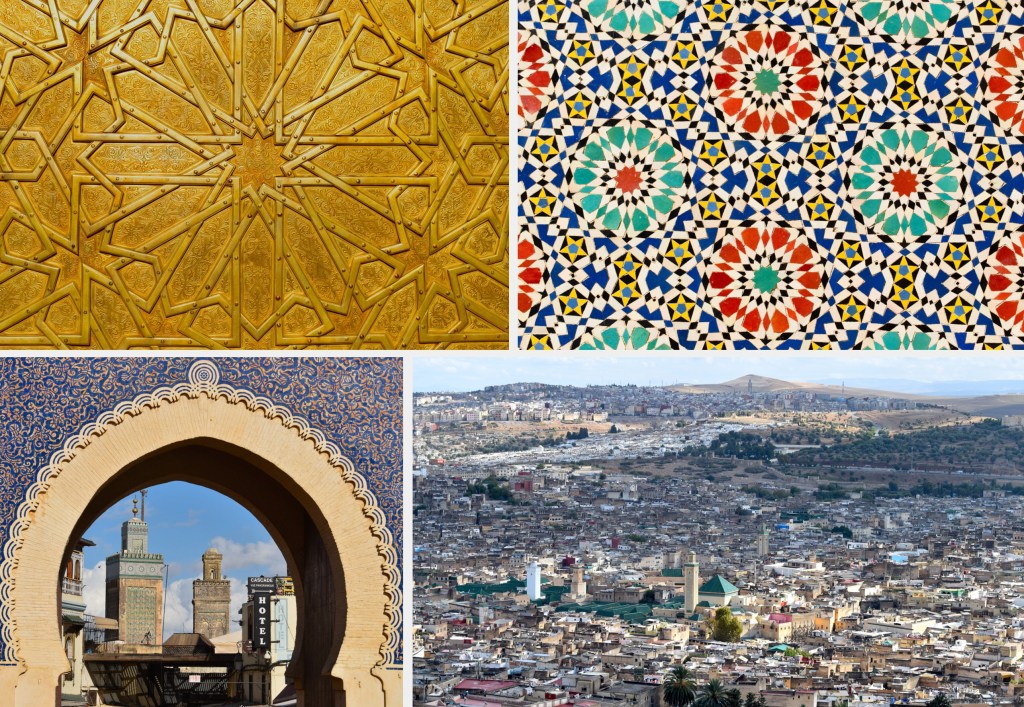
We thoroughly enjoyed our time with Mohammed and booked him for another half day tour later in the week. For our second outing, we hopped in a van and proceeded to drive to into the hills surrounding Fez, stopping along the ramparts to take in the views. Set in the lowlands between the Rif and Middle Atlas Mountain ranges in northern Morocco, Fez is stunning to see from a distance. Its location is perfect for growing grains, beans, olives, and grapes, and livestock including sheep, goats, and cattle dot the hills. Next, we went to the famous Blue Gate. Probably one of the most photographed places in Fez, the Bab Boujloud (Blue Gate) gets its name from the blue Fassi tiles on the outside. It was constructed in 1913 by the French in a Mauresque-Andalusian style. The original 12th century entrance is next to it. The Blue Gate serves as the main entrance to Fez El-Bali Medina (a UNESCO World Heritage Site since 1981 and the largest car-free area in the world.) It’s interesting to note that the other side of the gate which faces the medina is tiled in green, the color of Islam.
Mohammed took us to see one of the royal palaces in Fez and the largest one in Morocco, Dar al-Makhzen (Home to the King.) The palace itself is closed to visitors but the outside with its stunning gold doors and tilework is worth seeing. The original palace was constructed in the 13th century, and it underwent a massive reconstruction in 1864 under Sultan Mohammed ben Abdallah. Shortly after Morocco gained its independence in 1956, King Hassan II restored the entranceways and built a new grand square or Mechouar called Place des Alaouites. The seven ornate golden doors were added in the late 1960’s.
If a visit to Fez sounds intriguing, here are some tips to make your visit more enjoyable:
- The currency of Morocco is the dirham (MAD.) As cash machines in airports give notoriously bad exchange rates, only withdraw a small amount to start. There are cash machines at banks that offer better rates. Also, install a currency conversion app on your phone so you can see what things cost in your currency, thus avoiding sticker shock.
- Haggling over prices is the norm in Morocco so don’t settle for the first price given. We saved almost $100.00 on a leather jacket and got two beautiful hand-woven scarves for the price of one.
- Arabic is the most widely spoken language in Morocco with French being second. While English is becoming more common, only a few of the vendors we met spoke it. Be sure to learn how to say yes, no, please, thank you, hello, goodbye, and most importantly, how much is this and where are the toilettes in French.
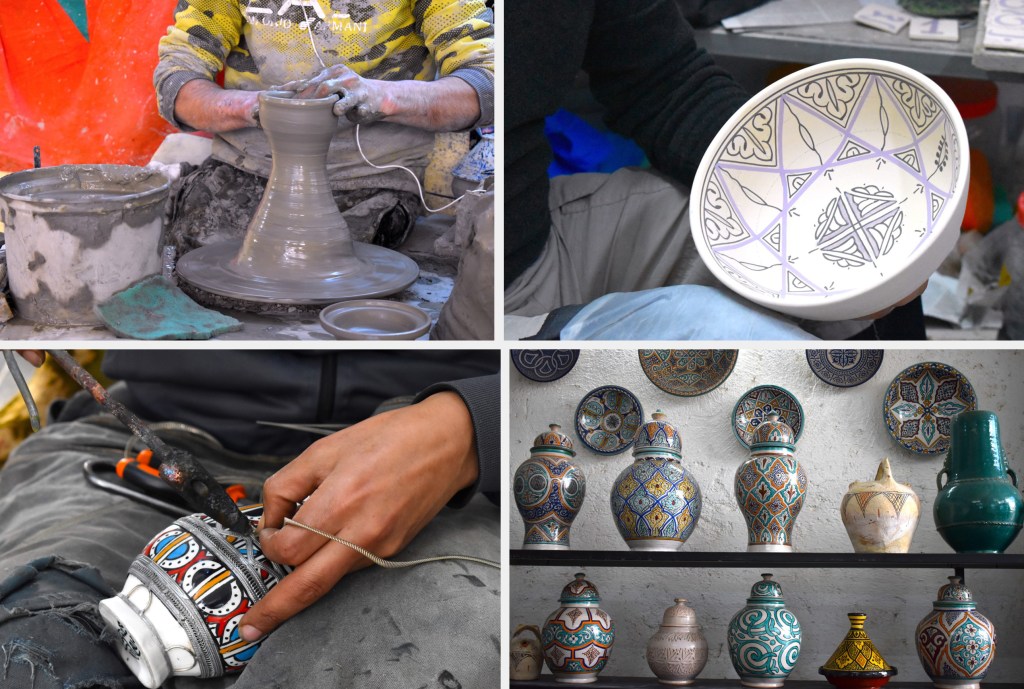
- All the Moroccan food we tried was delicious and packed with flavor. Nothing was too spicy for me, and many dishes were rather sweet as they contain dried fruits. Here’s a quick guide to common foods and dishes: Beef (lahm ba kar), Chicken (da jaj), Duck (but), Goat (ma hez), Lamb (ka roof), Rabbit (ar nab), Baghrir (semolina pancake), Boulfaf (lamb kebob), Harira (tomato-based soup usually with beans or lentils), Khobz (type of bread), Merguez (spicy sausage made from lamb), Ma’quda (potato fritter), Mrouzia (sweet dish of lamb with raisins, almonds, and honey), Rfisa (dish made with shredded pieces of pancake and chicken), and Tajine (dishes made in a conical clay pot.)
- As Muslims are forbidden to drink alcohol, you won’t be able to purchase it in any of the shops inside the Medina. Many hotels and riads offer it as do some restaurants. Our riad had a small selection of Moroccan wines and lagers and offered to stock the ones we liked best. For spirits and imports, there is a liquor shop at the shopping mall Borj Fes (easy to reach by taxi.)
In my next blog, we venture out of Fez and into the Middle Atlas Mountains to visit a ski resort town, the largest Atlas cedar forest in the world, and see the rare Barbary Macaques.


 Travels with Terri
Leave a reply to Terri Cancel reply