
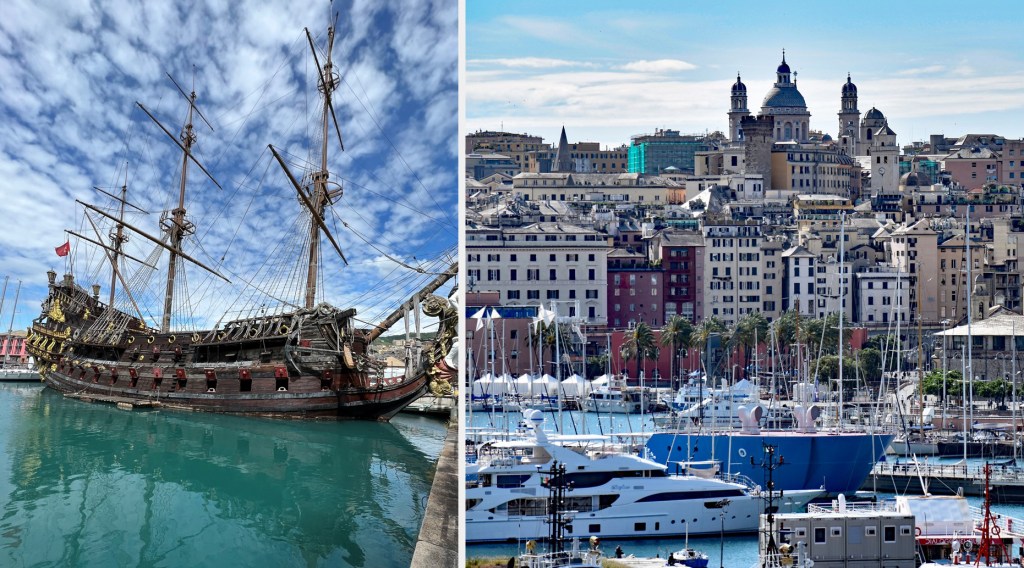
It has been said that “Rome wasn’t built in a day,” and this is certainly applies to Genoa (Genóva) Italy as well. Its earliest settlements are pre-Roman (from around the 4th and 5th centuries BC) making it one the of oldest continuously inhabited cities in the world. Historians believe that it was founded by the Ligurians, whose region once ranged from northwestern Italy to northeastern Spain. Throughout its tumultuous history, Genoa has been under the rule of the Romans, Byzantines, Franks, French, and Spaniards. Its “Golden Century” began in 1528 with the alliance between Admiral Andrea Doria and the Spanish Emperor Charles V after Doria and his forces drove the French out of the city. Genoese financial investments in Europe flourished, bringing riches into Genoa during the 16th and 17th centuries. With this wealth, noble families built grand palaces and Genoa earned the nickname of La Superba.
Instead of booking a group tour with Celebrity, we opted for a more personal experience and booked a private rickshaw tour with TreeCycle. They offer a variety of tours in Old Town Genoa ranging in length from one to four hours. We chose the two hour La Superba tour which includes the main attractions (Piazza De Ferrari, Via Garibaldi, the Cathedral of San Lorenzo), and the labyrinth of alleyways known as caruggi. Narrow and inaccessible by car, going by rickshaw was the perfect way to see these hidden parts of the city. Their host met us at the cruise ship terminal and escorted us to meet our guides. As we strolled along the waterfront, she told us about the history of Genoa, its maritime past, and its transformation into a popular tourist destination.
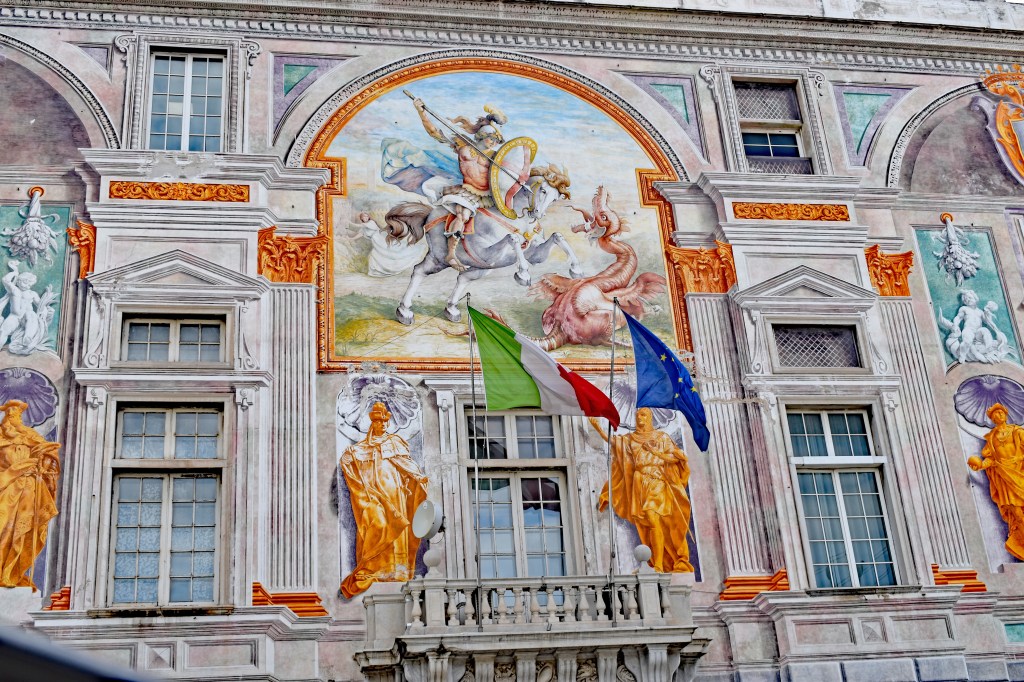
Our first stop was the impressive Palazzo San Giorgio near the port of Genoa. Dating back to the late 13th century, Guglielmo Boccanegra (Captain of the People from 1256 to 1262) believed that a public palace was needed and hired Benedictine friar Oliverio for its design and construction. Over the centuries, the palace has been the headquarters of the Banco di San Giorgio, the Autonomous Port Consortium, and most recently the Port System Authority of the Western Ligurian Sea. During WWII, parts of the palace were destroyed and remained damaged until restoration began in 1946. In 1990, Italian painter Raimondo Sirotti was hired to restore the painting of Saint George and the Dragon on the entrance portal of the palace. As we admired the intricate and colorful artwork, our guides asked if we could find the “fake” windows. Can you spot them?
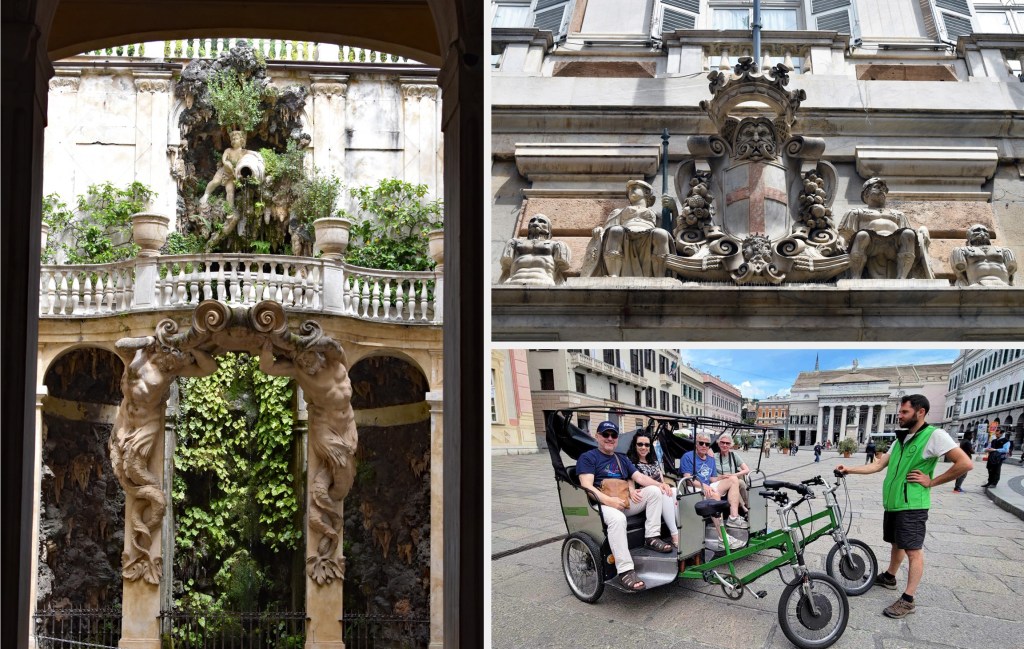
Next, we toured the famous Via (Steet) Giuseppe Garibaldi which is part of the UNESCO World Heritage Site of “The Strade Nuove and the system of the Palazzi del Rolli”. Home to numerous palaces, Strade Nuove (Italian for “new streets”) was the result of town planning aimed at transforming and expanding the existing medieval city. As wealth flowed into the city during the 1500’s and 1600’s, Genoese aristocracy wanted to expand their palaces and build larger and more opulent ones. Originally called Strada Nuova, its name was changed in 1882 in honor of General Giuseppe Garibaldi. Our guides told us that these wealthy families were required (at their own expense) to host visiting dignitaries and were chosen based on the nobility of the guest and the wealth of the host family. Rolli was a list of the most beautiful palaces in Genoa during the ancient Republic and the city hosts an annual Rolli days when more than 30 palaces are open to the public.

Quite modest on the outside, the interior of the Church of Santa Maria Maddalena is stunning and well worth a visit. The original chapel was erected in the 12th century and in the late 1500’s Italian architect Andrea Ceresola (known as Vannone) was hired to re-design and build a new church. The gorgeous frescoes were added in the 1700’s along with statues in both wood and marble. Other works of note are a wooden crucifix from the early 1300’s and the ornate pipe organ. As we made our way to the next stop, our guides told us that we could expect to see ladies who practice the ‘world’s oldest profession’ along the narrow alleyway. Genoa is indeed a city full of surprises!
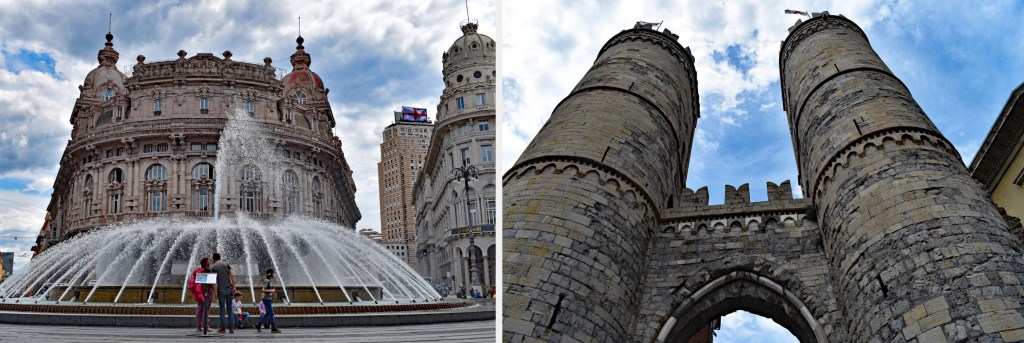
Our next stop was the impressive Piazza De Ferrari. Dedicated to the Italian banker and politician Raffaele De Ferrari (Duke of Galliera), it is the epicenter of Genoese life. Considered the financial and cultural hub of Genoa, it hosts numerous city events during the year. A main focal point is the monumental bronze fountain built in 1936 by the architect Giuseppe Crosa di Vergagni. After touring the Piazza, our guides took us to see one of the original gates in the city walls, Porta Soprana. During the 12th century, Holy Roman Emperor Frederick I of Swabia (known as Frederick Barbarossa) wanted to expand the Roman empire and set his sights on Genoa. Its citizens responded to the threat and provided both the funding and labor to build the walls and three two-towered gates. Called Barbarossa Walls, they were constructed between 1155 and 1159. The gates (Porta Soprana, Porta Aurea and Porta di Santa Fede) were completed in 1161. We learned that the two towers of Porta Soprana were used as a prison in the 1800’s as was the nearby monastery of St. Andrew.
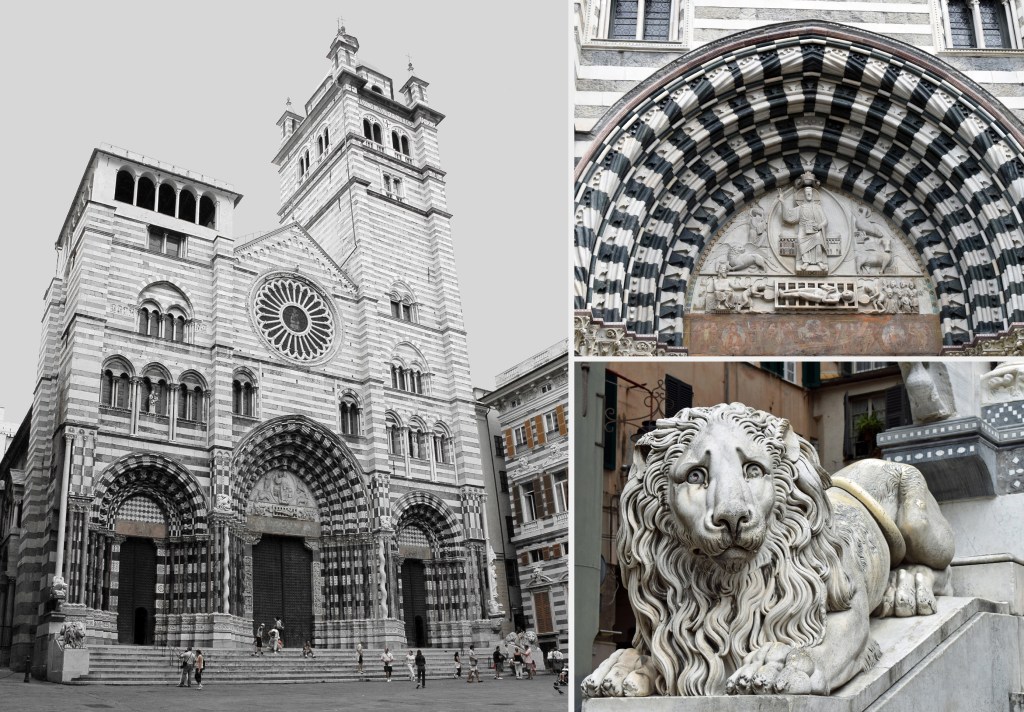
Our final stop of the tour was the Cathedral of San Lorenzo (Cattedrale di San Lorenzo.) Dedicated to Saint Lawrence, it was constructed in the late 1090’s and consecrated by Pope Gelasius II in 1118. After a fire in 1296, it was reconstructed, and the striking white and black striped façade was added between 1307 and 1312. The bell tower and dome are from the sixteenth century. A blend of Romanesque, Medieval, and Gothic styles, this architectural gem is a “must see” in Genoa.
In my next blog, I’ll address the inclusions and exclusions of “bargain” cruise prices. Stay tuned!
Cover Photo: View of Genoa from Reflection by Rick Gonzalez


 Travels with Terri
Leave a reply to Terri Cancel reply